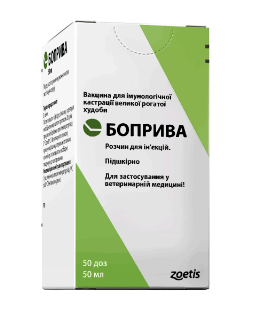
Each dose (1 ml) contains:
Active ingredient:
Gonadoliberin (GnRF) combined with carrier protein (synthetic peptide analogue of GnRF conjugated to diphtheria anatoxin) 0.4 mg
Adjuvants:
Diethylaminoethyl (DEAE) Dextran (aqueous adjuvant) 100 mg
immunostimulating complex* 0.8 mg;
Excipients:
Thiomersal 0.1 mg *- immunostimulant complex consists of Quil A, cholesterol and di-palmitol choline (DPPC).
Bopriva is a vaccine that stimulates the animal's immune system to produce specific antibodies against GnRF (Gonadotropin Releasing Factor).
А. The use of Bopriva in bulls results in the induction of antibodies against GnRF to produce a temporary decrease in testicular function in the post-pubertal bull. This is an alternative to physical castration to reduce blood testosterone. The onset of immunity can be expected within 1-2 weeks after the second vaccination, resulting in a decrease in blood testosterone levels for a minimum of 8 weeks and in most cases lasting up to 12 weeks.
Б. The use of Bopriva in heifers leads to the induction of antibodies against GnRF to produce a temporary decrease in GnRF function and side effects on luteinising hormone (LH) and follicle stimulating hormone (FSH). Bopriva causes a temporary immunological decrease in ovarian function in post-pubertal heifers, which leads to a decrease in estrogen and progesterone levels. Normal estrus activity begins to decline or ceases within 2 weeks (14 days) after the second vaccination. It is expected that in most heifers, the reduction or disappearance of characteristic estrus behaviour will last at least 16 weeks after the second vaccination. If it is necessary to extend the anestrus period, an additional buffer vaccination may be given.
The drug is administered subcutaneously in the neck in a dose of 1 ml.
Recommended vaccination schedule:
The first vaccination should be given 4 to 5 weeks before the expected effect. The second dose of Bopriv should be administered 3 weeks after the first dose, which is important for inhibition of GnRF activity. The duration of testosterone suppression in bulls can be prolonged by increasing the interval from 3 weeks to 8-12 weeks between the first and second doses. An interval of 3-4 weeks between the first and second doses is expected to result in 8 weeks of testosterone suppression, and an interval of 8-12 weeks is expected to result in testosterone suppression of approximately 16 weeks.
A third dose may be administered up to 52 weeks after the second dose if an additional period of testosterone reduction is required. One dose should be drawn from the vial using a sterile needle and syringe after disinfecting the cap of the vaccine vial. If an automated vaccination device is used for the vaccination process, the instructions for use of the automated vaccination device must be followed.
The drug is administered subcutaneously in the neck in a dose of 1 ml.
Dry, dark place at temperatures between 2°C and 8°C. Do not freeze!